30 French Expressions with the Verb “Faire” You Need to Know
Reading time: 13 min
Table of contents
- Why is the verb “faire” so important in French?
- French expressions with “faire” for everyday life
- Expressions with “faire” to talk about habits
- Expressions with “faire” for social situations
- Expressions with “faire” for work and holidays
- More informal expressions with “faire”
- Natural mini-dialogues with the verb “faire”
- Common mistakes to avoid
- Key takeaway
- FAQ
- Keep speaking French naturally
The verb faire is everywhere in French.
We use it to talk about sports.
Work.
Grocery shopping.
Mistakes.
Plans.
Holidays.
And sometimes even to say that we are doing nothing at all.
“Ce week-end, je vais faire la grasse matinée.”
If you are learning French, you probably already know the verb faire.
But knowing the verb is not enough.
To understand French people, you also need to know expressions with faire.
Because French people don’t always say things directly.
They say:
- faire attention,
- faire la queue,
- faire exprès,
- faire le pont,
- faire semblant,
- faire de son mieux.
The real goal:
Don’t translate word for word from your native language.
Learn French expressions as they are really used.
This way, you understand natural conversations better.
And you speak French more fluently.
Today, I’m giving you 30 French expressions with the verb faire.
With the English translation.
With the context.
And with concrete examples so you know when to use them.
Why is the verb “faire” so important in French?
The verb faire is one of the most used verbs in French.
It often means to do or to make in English.
For example:
- Je fais un gâteau. = I’m making a cake.
- Je fais mes devoirs. = I’m doing my homework.
- Je fais du sport. = I do sports.
But in French, faire goes much further.
It appears in dozens of very natural expressions.
And sometimes, these expressions cannot be translated directly into English.
The right reflex:
Don’t only learn the verb “faire”.
Learn complete expressions with “faire”.
Because in a real conversation, you don’t have time to build every sentence word by word.
Now let’s look at the most useful expressions.
French expressions with “faire” for everyday life
Let’s start with expressions you can hear every day.
1. Faire attention (to be careful / to pay attention)
This expression means to be careful or focused.
Example: “Fais attention en traversant la rue.”
2. Faire la queue (to wait in line)
Very useful in France, especially at the bakery, the post office or the supermarket.
Example: “On doit faire la queue pendant vingt minutes.”
3. Faire les courses (to go grocery shopping)
We use it to talk about everyday shopping, especially food shopping.
Example: “Je vais faire les courses après le travail.”
4. Faire le ménage (to clean the house)
It means to clean your apartment or house.
Example: “Je fais le ménage tous les samedis matin.”
5. Faire la cuisine (to cook)
This is a very natural way to say that you are preparing a meal.
Example: “Ce soir, c’est moi qui fais la cuisine.”
These expressions are simple, but they are essential.
You can use them in very everyday conversations.
And most importantly, they help you talk about your real life in French.
Do you want to speak French more naturally?
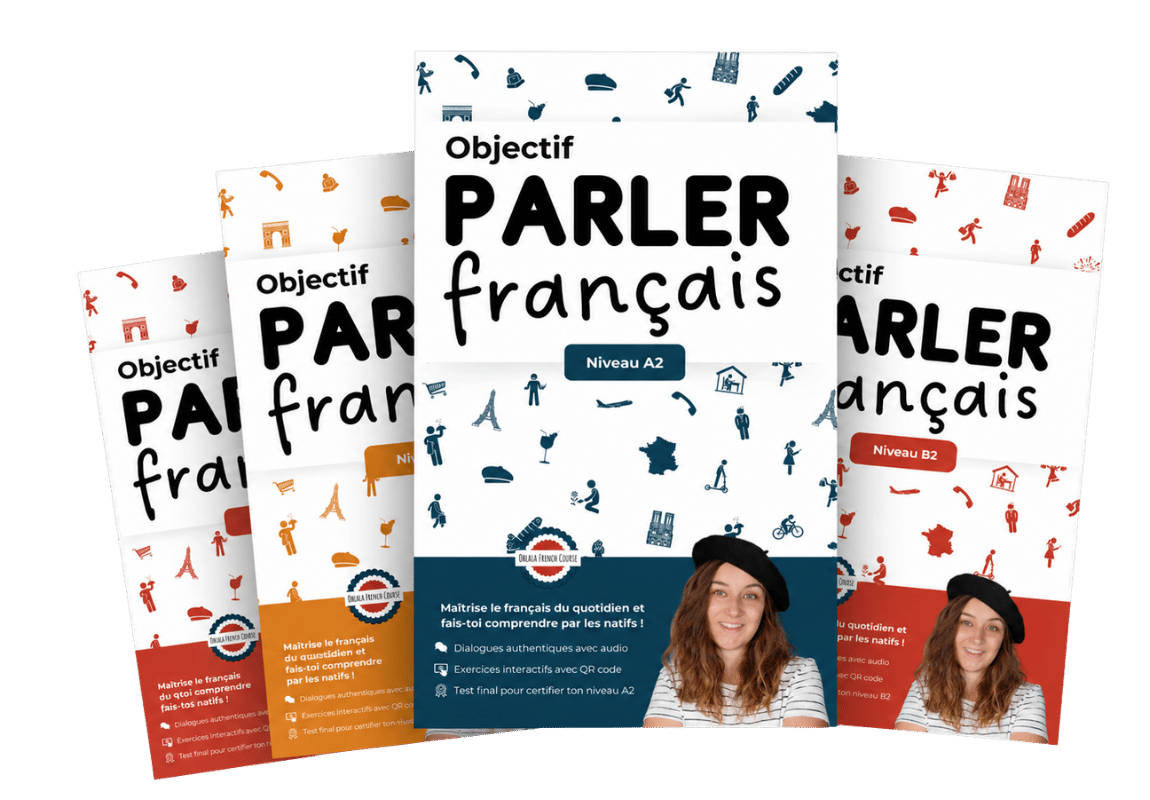
In my books Objectif : Parler Français, I help you learn useful, concrete and natural French.
Not just isolated words.
But phrases and expressions you can really use in a conversation.
Expressions with “faire” to talk about habits
The verb faire is also widely used to talk about habits and activities.
6. Faire du sport (to exercise / to do sports)
We use this expression to talk about physical activity.
Example: “Je fais du sport trois fois par semaine.”
7. Faire une promenade (to go for a walk)
A soft and natural expression to talk about a pleasant walk.
Example: “On fait une promenade au bord de la mer ?”
8. Faire la grasse matinée (to sleep in)
It means sleeping longer than usual, especially on the weekend.
Example: “Dimanche, j’ai fait la grasse matinée jusqu’à 10 heures.”
9. Faire une sieste (to take a nap)
Very useful after a meal or during the holidays.
Example: “Je vais faire une petite sieste.”
10. Faire ses devoirs (to do one’s homework)
We use it mostly for children, students or language learners.
Example: “Je dois faire mes devoirs de français ce soir.”
These expressions show that faire is very practical.
With just one verb, you can talk about many different activities.
Expressions with “faire” for social situations
Some expressions with faire are very useful to talk about other people.
What we show.
What we hide.
Or what we feel in a social situation.
11. Faire connaissance (to get to know someone / to meet for the first time)
We use this expression when we meet someone and start getting to know them.
Example: “On a fait connaissance pendant le dîner.”
12. Faire semblant (to pretend)
It means acting as if something were true, even though it is not.
Example: “Il fait semblant de comprendre, mais il est perdu.”
13. Faire exprès (to do something on purpose)
Very important: this expression means that an action is intentional.
Example: “Tu as renversé ton café ? — Non, je n’ai pas fait exprès !”
14. Faire confiance à quelqu’un (to trust someone)
We use this expression to talk about trust.
Example: “Je lui fais confiance.”
15. Faire plaisir à quelqu’un (to make someone happy / to please someone)
This expression is very common when talking about a kind gesture.
Example: “Je lui ai offert des fleurs pour lui faire plaisir.”
Be careful:
In French, we say “faire confiance à quelqu’un”.
Not “donner confiance à quelqu’un” if you mean to trust someone.
Correct example: “Je fais confiance à mon professeur.”
Expressions with “faire” for work and holidays
The verb faire is also everywhere in the world of work, studies and holidays.
16. Faire une pause (to take a break)
Very useful at work, in class or during an activity.
Example: “On fait une pause de dix minutes ?”
17. Faire le pont (to take an extra day off between a public holiday and the weekend)
A very French expression. If a public holiday falls on a Thursday, many French people take Friday off to have a long weekend.
Example: “Le 15 août tombe un jeudi, donc je fais le pont.”
18. Faire des heures supplémentaires (to work overtime)
We use this expression when someone works more than their usual hours.
Example: “Cette semaine, j’ai fait beaucoup d’heures supplémentaires.”
19. Faire un effort (to make an effort)
A very common expression to talk about motivation or progress.
Example: “Il faut faire un effort pour parler français tous les jours.”
20. Faire de son mieux (to do one’s best)
A beautiful expression to say that you are trying as much as possible.
Example: “Je fais de mon mieux pour améliorer mon français.”
These expressions are perfect if you want to talk about your routine, your work or your learning process.
They are simple.
But they sound very natural.
More informal expressions with “faire”
Now let’s look at a few slightly more informal expressions.
You can hear them in conversations with friends, in French TV shows or in everyday life.
21. Faire la tête (to sulk)
It means being in a bad mood and showing it.
Example: “Pourquoi tu fais la tête ?”
22. Faire n’importe quoi (to do anything / to mess around / to act irresponsibly)
This expression depends on the context. It can mean acting without thinking.
Example: “Arrête, tu fais n’importe quoi !”
23. Faire une bêtise (to do something silly / to make a mistake)
Often used with children, but also between adults in a light tone.
Example: “Le chien a encore fait une bêtise.”
24. Faire la fête (to party)
A very common expression to talk about a party or festive moment.
Example: “On a fait la fête toute la nuit.”
25. Faire un tour (to go for a short walk / to take a look around)
Very natural when suggesting going out or looking around quickly.
Example: “On va faire un tour en ville ?”
These expressions are very useful if you want to understand spoken French.
They often appear in natural conversations.
And they immediately make your French sound more authentic.
Quick tip:
Don’t try to learn all 30 expressions at once.
Choose 5 expressions.
Write 5 personal sentences.
Then use them in a real conversation or out loud.
26. Faire peur (to scare)
We use this expression when something or someone causes fear.
Example: “Ce film me fait peur.”
27. Faire rire (to make someone laugh)
Very simple and very common.
Example: “Cette vidéo me fait rire.”
28. Faire mal (to hurt)
We use it to talk about physical pain or sometimes emotional pain.
Example: “J’ai mal au dos” is more common, but you can say: “Cette position me fait mal au dos.”
29. Faire chaud / faire froid (to be hot / to be cold, for the weather)
Be careful: to talk about the weather, we often use “il fait”.
Example: “Il fait froid aujourd’hui.”
30. Faire partie de (to be part of)
A very useful expression to talk about a group, a team or an experience.
Example: “Elle fait partie de notre groupe de conversation.”
Natural mini-dialogues with the verb “faire”
Now let’s see these expressions in real mini-dialogues.
Dialogue 1: at the bakery
— Il y a beaucoup de monde ?
— Oui, il faut faire la queue.
— Bon, on attend alors.
Dialogue 2: the weekend
— Tu as prévu quelque chose dimanche ?
— Oui, dormir.
— Ah, tu vas faire la grasse matinée ?
— Exactement.
Dialogue 3: at work
— On peut faire une pause ?
— Oui, bonne idée. Je suis fatigué.
— Moi aussi, j’ai fait beaucoup d’heures supplémentaires cette semaine.
Dialogue 4: between friends
— Pourquoi tu fais la tête ?
— Je ne fais pas la tête.
— Si, un peu.
— Bon, d’accord, je suis un peu énervé.
Dialogues help you understand the context.
Because an expression is never alone.
It lives in a situation.
With an intention.
And often with an emotion.
Common mistakes to avoid
With the verb faire, some mistakes are very common.
Here are the most important ones.
Mistake 1: translating directly from English
In English, you say to take a nap.
In French, we say: faire une sieste.
Not: “prendre une sieste”.
Mistake 2: forgetting the preposition
We say: “faire confiance à quelqu’un”.
Example: “Je fais confiance à mon ami.”
Mistake 3: confusing “faire” and “prendre”
We say: “faire une pause” or “prendre une pause”. You can hear both.
But we say: “faire la queue”, not “prendre la queue”.
Mistake 4: using “je suis chaud” for the weather
To talk about the weather, say: “Il fait chaud.”
“Je suis chaud” can have a very different meaning depending on the context.
The secret is to learn expressions as blocks.
Not word by word.
This way, your French becomes faster, more natural and more confident.
Key takeaway
The verb faire is essential in French.
But to truly use it like French people, you need to learn the expressions that go with it.
Remember:
- “Faire attention” = to be careful.
- “Faire la queue” = to wait in line.
- “Faire exprès” = to do something on purpose.
- “Faire le pont” = to take a day off between a public holiday and the weekend.
- “Faire de son mieux” = to do one’s best.
If you know these expressions, you will understand many more French conversations.
And most importantly, you will be able to speak more naturally.
FAQ
What is the difference between “faire” and “prendre”?
It depends on the expression. In French, we say “faire la queue”, “faire une sieste”, “faire attention”, but also “prendre une décision” or “prendre le train”. You need to learn expressions in context.
Does “faire” always mean “to do” or “to make”?
No. In many expressions, “faire” is not translated literally. For example, “faire la grasse matinée” means “to sleep in”.
Which expression with “faire” is the most useful?
“Faire attention” is probably one of the most useful, because it can be used in many situations.
How can I memorize these expressions?
Write a personal sentence with each expression. For example: “Je fais de mon mieux pour parler français tous les jours.” It is more effective than learning a list without context.
Keep speaking French naturally
Learning expressions like these is an excellent way to improve your French.
Because you no longer speak only with isolated words.
You speak with natural phrases.
Phrases French people really use.
And that is exactly the goal of the books Objectif : Parler Français.
Do you want to speak French more fluently?
Discover my books Objectif : Parler Français.
You will find practical French.
Natural phrases.
Concrete situations.
And tools to progress at your own pace.
→ Discover Objectif : Parler Français= 30 French expressions with the verb “faire”.
Learn them.
Practise them.
And use them in your next French conversations.
Ready to speak with the right words, naturally?
Join Ohlala French School and turn vocabulary into real, confident conversations.
Start your 7-day free trial