5 Verbs That Let You Speak French in 90% of Everyday Situations
Reading time: 13 minutes
🇫🇷 In short: With être, avoir, faire, aller and pouvoir, you can introduce yourself, talk about your needs, describe your day, ask for something, and explain your plans. Discover 25 ready-to-use patterns.
The “90%” in the title is not an exact linguistic statistic. It expresses a practical idea: these five verbs are so common and versatile that they help you communicate in a huge range of everyday situations, even with limited vocabulary. The most effective approach is not to memorise conjugations in isolation, but to learn the complete patterns French speakers actually use.
The 5 essential verbs
- Être
- Avoir
- Faire
- Aller
- Pouvoir
1. ÊTRE
Say who you are, describe your state, give an opinion, and locate a person or thing.
« Je suis… »
When to use it : Talk about your identity, job, or current state.
Example : Je suis canadienne. Je suis responsable marketing. Je suis fatigué aujourd’hui.
Remember : Remember adjective agreement when needed: fatigué/fatiguée.
« Je suis en train de… »
When to use it : Emphasise an action that is in progress as you speak.
Example : Je ne peux pas parler maintenant, je suis en train de travailler.
Remember : Add an infinitive after « de ». In many contexts, the simple present also works.
« Je suis d’accord. »
When to use it : Clearly express agreement.
Example : On se retrouve à 19 heures ? Oui, je suis d’accord.
Remember : To disagree tactfully: « Je ne suis pas tout à fait d’accord. »
« C’est… »
When to use it : Describe or comment on almost any situation.
Example : C’est intéressant. C’est trop cher. C’est une bonne idée.
Remember : « C’est » can be followed by a noun, noun phrase, or commonly an adjective in everyday speech.
« Où est… ? »
When to use it : Ask where a person, place, or object is.
Example : Excusez-moi, où est la gare ? Où sont les toilettes ?
Remember : Use « où sont » with a plural subject.
2. AVOIR
Express needs, wishes, age, and many physical sensations.
« J’ai besoin de… »
When to use it : Express a need or necessity.
Example : J’ai besoin d’aide. J’ai besoin d’un taxi. J’ai besoin de réfléchir.
Remember : After « de », you can use a noun or an infinitive.
« J’ai envie de… »
When to use it : Express a desire or something you feel like doing.
Example : J’ai envie d’un café. J’ai envie de sortir ce soir.
Remember : « Besoin » is a need; « envie » is a desire.
« J’ai le temps. »
When to use it : Say that you have time—or that you do not.
Example : Tu peux m’aider ? Oui, j’ai le temps. / Désolé, je n’ai pas le temps aujourd’hui.
Remember : The negative form goes around the verb: « je n’ai pas ».
« J’ai un problème avec… »
When to use it : Calmly report a specific problem.
Example : Excusez-moi, j’ai un problème avec ma commande.
Remember : Naming the exact problem helps the other person respond.
« Il y a… »
When to use it : Say that something exists or is present.
Example : Il y a un supermarché près d’ici. Est-ce qu’il y a une table disponible ?
Remember : The form does not change before a plural: « Il y a beaucoup de monde. »
3. FAIRE
Talk about activities, duration, weather, and your reactions.
« Qu’est-ce que tu fais ? »
When to use it : Ask what someone is doing now or, depending on context, what they do for work.
Example : Qu’est-ce que tu fais ce soir ? / Qu’est-ce que tu fais dans la vie ?
Remember : Add « dans la vie » to clearly ask about someone’s profession.
« Je fais… »
When to use it : Talk about a common activity.
Example : Je fais du sport, je fais les courses et je fais la cuisine.
Remember : Learn these combinations as chunks: faire du sport, faire les courses, faire une pause.
« Ça fait… que… »
When to use it : Say how long an action has been continuing.
Example : Ça fait deux ans que j’apprends le français.
Remember : This pattern generally uses the present tense for an action that is still continuing.
« Il fait… »
When to use it : Talk about weather or temperature.
Example : Il fait beau. Il fait froid. Il fait 25 degrés.
Remember : For rain, say « Il pleut », not « il fait pluie ».
« Ça me fait… »
When to use it : Express the reaction caused by a situation.
Example : Ça me fait plaisir. Ça me fait rire. Ça me fait penser à mon enfance.
Remember : Depending on the reaction, follow it with a noun, infinitive, or set expression.
Learn words through real sentences
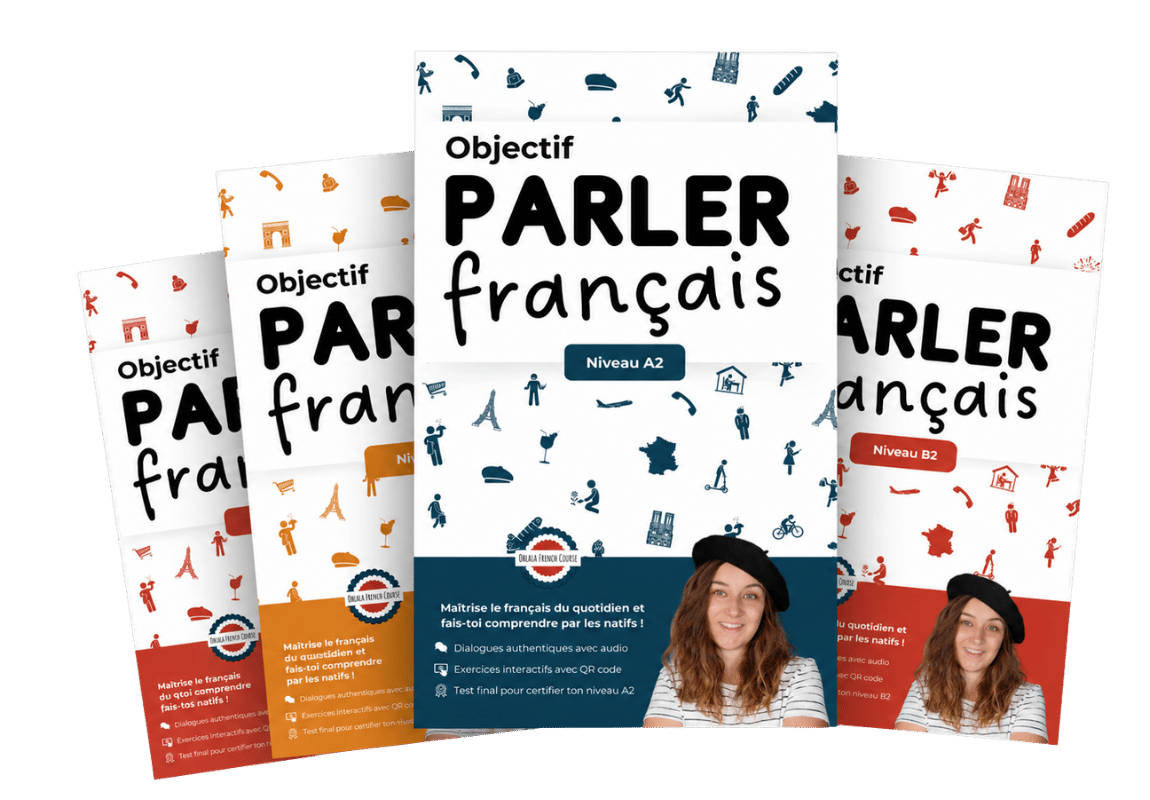
In the Objectif : Parler Français books, vocabulary appears in natural dialogues with native-speaker audio. You learn to reuse complete patterns, not just recognise isolated words.
4. ALLER
Talk about movement, how you are, what suits someone, and future plans.
« Je vais à/au/chez… »
When to use it : Say where you are going.
Example : Je vais à Paris, au travail et chez le médecin.
Remember : « Chez » is commonly used before a person or a healthcare professional.
« Comment ça va ? »
When to use it : Ask how someone is feeling.
Example : Comment ça va aujourd’hui ? Ça va très bien, merci.
Remember : Natural replies include « Ça va mieux » and « Ça ne va pas très fort ».
« Ça te va ? »
When to use it : Check whether a time, proposal, or even an item of clothing suits someone.
Example : On se retrouve à 18 heures. Ça te va ?
Remember : With « vous », say « Ça vous va ? »
« Je vais + infinitif. »
When to use it : Talk simply about a plan or future action.
Example : Demain, je vais appeler le client et je vais préparer le dossier.
Remember : This is the near future: conjugate « aller », then add the infinitive.
« On y va ? »
When to use it : Suggest leaving or getting started.
Example : Tout le monde est prêt ? On y va ?
Remember : « Allez, on y va ! » can also encourage the group to begin.
5. POUVOIR
Express ability, ask permission, offer help, or refuse politely.
« Je peux… »
When to use it : Talk about what you are able or available to do.
Example : Je peux t’aider. Je peux venir demain. Je peux payer par carte ?
Remember : In speech, intonation is often enough to turn the sentence into a question.
« Est-ce que je peux… ? »
When to use it : Ask for permission clearly and politely.
Example : Est-ce que je peux ouvrir la fenêtre ?
Remember : Add « s’il vous plaît » in a more formal situation.
« Tu peux… ? / Vous pouvez… ? »
When to use it : Ask someone to do something.
Example : Vous pouvez répéter plus lentement, s’il vous plaît ?
Remember : Use « vous pouvez » with someone you address formally or with several people.
« On peut… ? »
When to use it : Make a suggestion or ask what is possible for the group.
Example : On peut réserver une table ? On peut en parler demain ?
Remember : This pattern is extremely common and natural in conversation.
« Je ne peux pas. »
When to use it : Refuse or state that something is impossible without only saying “no.”
Example : Désolé, je ne peux pas venir ce soir. J’ai déjà quelque chose de prévu.
Remember : A softer future form is « Je ne vais pas pouvoir venir. »
A mini-conversation using all 5 verbs
— Bonjour, je suis ici pour la réunion de 14 heures.
— Très bien. Il y a une salle libre au deuxième étage.
— Parfait. Est-ce que je peux attendre ici ?
— Bien sûr. Comment ça va aujourd’hui ?
— Très bien. Ça fait six mois que je travaille sur ce projet et je vais présenter les premiers résultats.
— Excellent. Tout le monde est arrivé. On peut commencer ?
— Oui, on y va !
In this short dialogue, these five verbs are enough to introduce yourself, ask permission, talk about duration, announce a plan, and start a meeting.
Your turn
Write five personal sentences, one with each verb. For example: « Je suis professeur. J’ai envie de voyager. Je fais du français tous les jours. Je vais visiter Lyon. Je peux déjà avoir une petite conversation. » Then repeat them aloud until they become automatic.
Learn words through real sentences
In the Objectif : Parler Français books, vocabulary appears in natural dialogues with native-speaker audio. You learn to reuse complete patterns, not just recognise isolated words.
Ready to stop overthinking and speak French with confidence?
Join Ohlala French School to practice grammar in real-life conversations and make it automatic.
Start your 7-day free trial