Understand French People When They Speak Fast: The Shadowing Technique
Reading time: 9 minutes
🇫🇷 In short: if you understand French when someone speaks slowly, but feel lost when French people speak naturally, the problem is not necessarily your vocabulary.
Your ear may not be trained enough for real spoken French yet. Shadowing can help you recognise the sounds, rhythm, contractions and word groups used in real conversations.
You understand French when someone speaks slowly. But as soon as two French people speak naturally to each other, you may feel like they swallow the words, speak too fast, and your brain cannot keep up.
And yet, very often, you already know the words.
You know je ne sais pas. You know tu as vu. You know ce que tu veux dire. But when a French person says j’sais pas c’que tu veux dire, your brain may freeze.
So the problem is not only vocabulary. The problem is that your ear is not trained enough for naturally spoken French.
In this article, I’ll show you a very simple technique to better understand French people when they speak fast: shadowing.
📚 Do you want to practise shadowing with a structured method?
In my books Objectif : Parler Français, each chapter includes a shadowing exercise to help you improve your spoken French: listen, repeat, follow the rhythm, work on your pronunciation, then reuse the vocabulary in a real communication situation.
The collection is available from A2 to C1, so you can progress step by step.
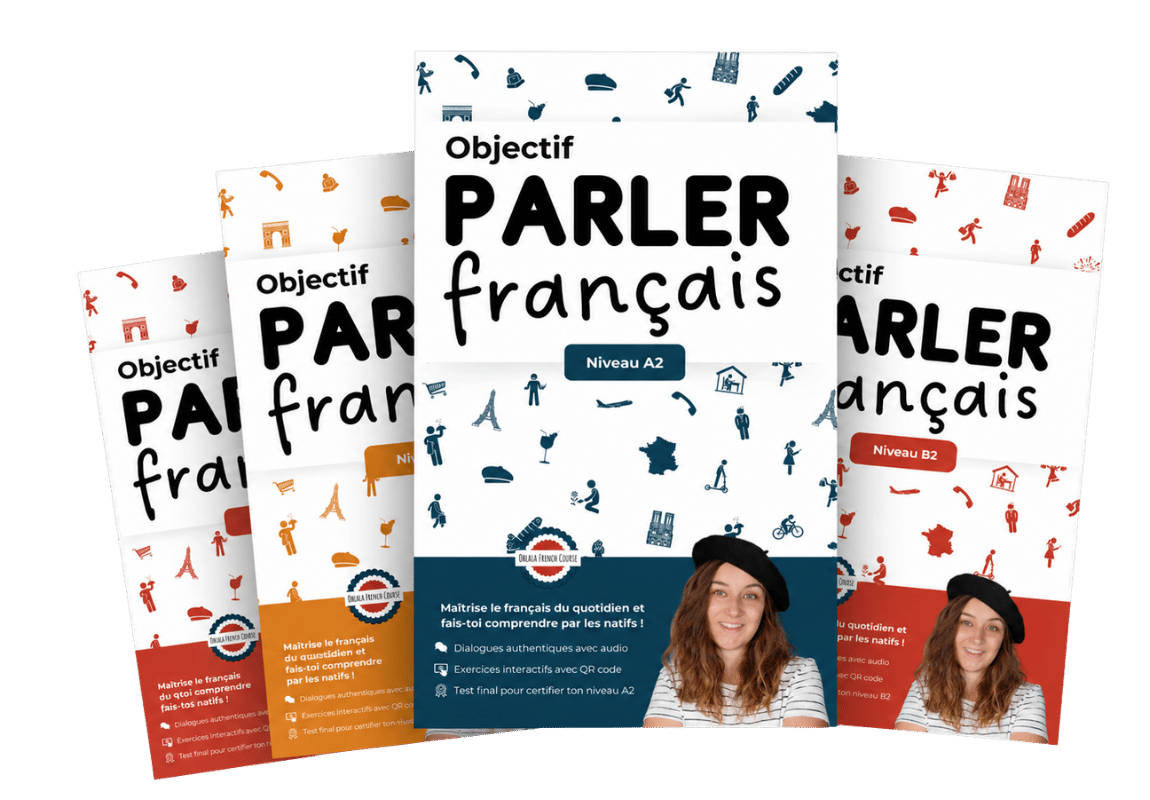
Table of contents
What is shadowing?
Shadowing is a technique where you listen to a sentence in French and repeat it almost at the same time as the speaker.
Like a shadow. That is why it is called shadowing.
You do not translate. You do not do a long grammar analysis. You listen and follow the voice.
Example:
If I hear: Je sais pas ce que tu en penses, mais moi, je trouve ça intéressant.
I try to repeat almost at the same time, with the same rhythm and intonation.
The goal is not to be perfect. The goal is to train your ear and your mouth to work together.
Because very often, your brain knows the words, but your ear does not recognise them fast enough, and your mouth does not yet know how to produce them naturally.
Shadowing creates a link between three things:
- what you hear;
- what you understand;
- what you say.
Why French people are difficult to understand ?
Why do French people seem to speak so fast? It is not only a question of speed.
It is mostly because in natural French, many things change between written French and spoken French.
In written French, we say: Je ne sais pas.
In spoken French, we often say: Je sais pas. Or even: J’sais pas.
Written French: Tu as vu ce qu’il a dit ?
Spoken French: T’as vu c’qu’il a dit ?
Written French: Je suis en train de regarder.
Spoken French: J’suis en train d’regarder.
Do you see the problem?
You may have learned a clear, clean, school version of French. But in real life, French people contract words, drop some syllables, make liaisons and change the rhythm.
They do not speak word by word. They speak in sound groups.
And if your ear is not trained to recognise these sound groups, your brain panics. It thinks: “I know these words, but I can’t hear them.”
Shadowing helps you recognise these natural forms.
Why shadowing works?
Shadowing works because it turns passive listening into active listening.
When you watch a video in French, you listen. That is already good. But sometimes, you stay passive.
With shadowing, you need to listen precisely. You need to notice the rhythm. You need to reproduce the sounds. You need to place your mouth. You need to follow the intonation.
And the more you repeat, the more your brain creates new automatic patterns. This is linked to neuroplasticity: the brain’s ability to adapt, create new connections and automate certain things.
At the beginning, it is difficult. You hear: J’sais pas c’que tu veux dire. And your brain thinks: “Wait… what was that?”
But after repeating, your brain starts to recognise:
- J’sais pas = je ne sais pas;
- c’que = ce que;
- t’as vu = tu as vu.
Little by little, you no longer hear only fast sounds. You recognise blocks of meaning.
How to do shadowing?
To do shadowing, you can follow three simple steps.
Step 1: listen without speaking
Listen to the sentence once to understand the general meaning. You can read the transcript at first, especially if the audio is new.
Step 2: repeat after the audio
Pause, repeat slowly, start again. Here, you can take your time. The goal is to understand the sentence and feel how it is pronounced.
Step 3: repeat almost at the same time
Now, follow the voice. Try to copy the rhythm, intonation, pauses and music of the sentence.
Important: do not look for perfection. Shadowing is not an exam. It is training. If you forget a word, it is okay. If your pronunciation is not perfect, it is okay. The goal is to train your brain, ear and mouth for natural French.
3 shadowing exercises to practise?
Now let’s practise. Read the sentences out loud. Then repeat them a second time, trying to go a little faster, with a more natural rhythm.
Level 1: clear sentence
Start with clear sentences, without too many contractions.
Sentence 1: Je voudrais parler français plus naturellement.
Sentence 2: J’ai du mal à comprendre les Français quand ils parlent vite.
At this level, the goal is simple: you hear the sentence, you understand the sentence, and you train your mouth to produce it.
Level 2: more natural French
Now, let’s move from slightly academic French to more natural French.
Written sentence: Je ne sais pas ce que tu veux dire.
Spoken French: J’sais pas c’que tu veux dire.
Written sentence: Tu as compris ce qu’il a dit ?
Spoken French: T’as compris c’qu’il a dit ?
Here, you are not only practising words. You are practising the music of the sentence. Because natural French is not a list of separate words. It is a rhythm.
Level 3: mini-conversation
Now try with a more natural mini-conversation.
Franchement, j’sais pas trop quoi en penser. J’ai l’impression qu’il parle super vite. Mais en vrai, plus tu t’entraînes, plus ça devient naturel.
You can break it down like this:
- Franchement, j’sais pas trop quoi en penser.
- J’ai l’impression qu’il parle super vite.
- Mais en vrai, plus tu t’entraînes, plus ça devient naturel.
If you find this difficult, it is normal. It means you are working exactly on the area that blocks you in real conversations.
The 3 mistakes to avoid with shadowing?
Mistake 1: choosing audio that is too difficult
If you choose a very fast conversation with a lot of slang, several people and background noise, you will get discouraged. Choose audio that is slightly difficult, but not impossible.
Mistake 2: trying to translate everything
During shadowing, do not translate every word. Try to stay in the rhythm of French. You can check the meaning before or after, but during the exercise, follow the voice.
Mistake 3: practising only once
Shadowing works through repetition. It is better to practise five minutes a day for a week than thirty minutes only once.
And most importantly, do it out loud. Not only in your head. Because speaking French is also physical. Your mouth, tongue and muscles need to get used to French sounds.
A simple 5-day routine
Here is a very simple routine to practise shadowing without making it complicated.
- Day 1: choose a short extract of 20 to 30 seconds. Listen and read the transcript.
- Day 2: repeat sentence by sentence.
- Day 3: do shadowing with the audio.
- Day 4: repeat the same extract.
- Day 5: do shadowing again and record yourself if possible.
Do not change audio every day. Repetition is very important.
At first, your brain makes a lot of effort. Then, little by little, some sentences become more natural. This is how you move from: “I understand when it is written” to: “I understand when a French person speaks naturally.”
The perfect combo: shadowing + conversation
Shadowing is very powerful because you can do it alone. You can practise at home, with audio, a transcript and a few minutes a day.
But to progress even more, you then need to use what you have trained in a real interaction. That is why shadowing + daily conversation is the perfect combo.
Shadowing trains your ear, mouth and rhythm. Conversation helps you use these automatic patterns in real life.
Do you want to speak French more naturally?
In the books Objectif : Parler Français, each chapter contains a shadowing exercise to improve your spoken French.
You can listen, repeat, follow the rhythm, work on your pronunciation, then use the vocabulary and structures in concrete conversations.
The goal is not only to understand French. The goal is to speak French more naturally, with more confidence, in real life.
Conclusion
If you feel like French people speak too fast, do not tell yourself that you are bad at French.
Tell yourself instead: my ear needs training with real French.
Shadowing helps you recognise contractions, sounds, rhythm and word groups that French people use naturally.
Start with a short extract. Repeat it for several days. Do it out loud. And above all, do not look for perfection.
Your goal is simple: to hear real French more clearly, and to speak with more fluency.
Your turn to practise: which sentence is the most difficult for you?
- J’sais pas c’que tu veux dire.
- T’as compris c’qu’il a dit ?
- Franchement, j’sais pas trop quoi en penser.
Ready to speak with the right words, naturally?
Join Ohlala French School and turn vocabulary into real, confident conversations.
Start your 7-day free trial